It’s been a couple years since I heard the phrase from Gary Vee “Document, don’t create” and it’s been something that has been on my mind a lot.
The phrase takes away “writer’s block” and creative fog. It takes the quantity over quality approach, suggesting that if we keep track of and analyze the things we are already doing, we will find that they can be just as unique and interesting as our one off moments of inspiration.
This documentation process goes hand in hand with the idea of a grassroots approach to everything. We humans tend to overcomplicate the easiest things and often put blame on ourselves for not having the proper equipment or expertise in order to even start. The concept of “just starting” and “documenting” applies the KISS method (keep it simple stupid) and feels less “sexy” to us. No one wants to start at Day 1, admit to others that they are just figuring things out, or trying out new things. But we can’t get to point Z without A. And I find that instead of waiting for creativity to spark, waiting for that perfect path to be laid out in front of us to get to our destination, we need to just get in the car and start driving.
Yes, you can chew gum and walk at the same time. But when it comes to thinking about two unrelated problems, its best to write them both down, and focus all energy on solving one first, before hoping over to the second.
Notes taken from Naval Ravikant – placed here for my own personal reference(personal favorites are italicized)
Seek wealth, not money or status. Wealth is having assets that earn while you sleep. Money is how we transfer time and wealth. Status is your place in the social hierarchy.
Understand ethical wealth creation is possible. If you secretly despise wealth, it will elude you.
Ignore people playing status games. They gain status by attacking people playing wealth creation games.
You’re not going to get rich renting out your time. You must own equity—a piece of a business—to gain your financial freedom
You will get rich by giving society what it wants but does not yet know how to get. At scale.
Pick an industry where you can play long-term games with long-term people
The internet has massively broadened the possible space of careers. Most people haven’t figured this out yet.
Play iterated games. All the returns in life, whether in wealth, relationships, or knowledge, come from compound interest
Pick business partners with high intelligence, energy, and, above all, integrity
Don’t partner with cynics and pessimists. Their beliefs are self-fulfilling.
Learn to sell. Learn to build. If you can do both, you will be unstoppable
Arm yourself with specific knowledge, accountability, and leverage
Specific knowledge is knowledge you cannot be trained for. If society can train you, it can train someone else and replace you.
Specific knowledge is found by pursuing your genuine curiosity and passion rather than whatever is hot right now
Building specific knowledge will feel like play to you but will look like work to others
When specific knowledge is taught, it’s through apprenticeships, not schools
Specific knowledge is often highly technical or creative. It cannot be outsourced or automated
Embrace accountability, and take business risks under your own name. Society will reward you with responsibility, equity, and leverage
Fortunes require leverage. Business leverage comes from capital, people, and products with no marginal cost of replication (code and media)
Capital means money. To raise money, apply your specific knowledge with accountability and show resulting good judgment
Labor means people working for you. It’s the oldest and most fought-over form of leverage. Labor leverage will impress your parents, but don’t waste your life chasing it.
Capital and labor are permissioned leverage. Everyone is chasing capital, but someone has to give it to you. Everyone is trying to lead, but someone has to follow you
Code and media are permissionless leverage. They’re the leverage behind the newly rich. You can create software and media that works for you while you sleep
An army of robots is freely available—it’s just packed in data centers for heat and space efficiency. Use it
If you can’t code, write books and blogs, record videos and podcasts
Leverage is a force multiplier for your judgment.
Judgment requires experience but can be built faster by learning foundational skills.
There is no skill called “business.” Avoid business magazines and business classes
Study microeconomics, game theory, psychology, persuasion, ethics, mathematics, and computers
Reading is faster than listening. Doing is faster than watching.
You should be too busy to “do coffee” while still keeping an uncluttered calendar.
Set and enforce an aspirational personal hourly rate. If fixing a problem will save less than your hourly rate, ignore it. If outsourcing a task will cost less than your hourly rate, outsource it
Work as hard as you can. Even though who you work with and what you work on are more important than how hard you work
Become the best in the world at what you do. Keep redefining what you do until this is true.
There are no get-rich-quick schemes. Those are just someone else getting rich off you.
Apply specific knowledge, with leverage, and eventually you will get what you deserve
When you’re finally wealthy, you’ll realize it wasn’t what you were seeking in the first place. But that is for another day
It’s a known fact that if you play enough games of Tetris, many people will begin to play the game in real life, envisioning how shapes in the real world might fit together.
You may be strolling through a store and see how the boxes on the shelf could stack nicely together, even potentially envisioning boxes falling down into place to fill certain holes or gaps.
This is just another example of how powerful the mind is, and how what we feed it can (and will) control our thoughts.
What if, instead of just walking through life and going through the motions, we were always attuned to various patterns?
What if, instead of our normal challenges/struggles of daily life, we primed ourselves to only see the opportunities they might bring?
But be prepared for a lot of those miniature hard nuggets to never yield any of the delicious white, fluffy, goodness we love to dump butter on at the movies.
No one frets over the un-popped kernels, they just serve up more kernels for another bag of soon-to-be popcorn.
We can treat creativity like this.
Our minds can be the machine that dishes up those kernels (ideas).
While a lot of these ideas can come to nothing, other ideas can bear a delicious snack (worthwhile pursuit/business/endeavor)
We all can be popping with creativity, if we are willing to keep throwing ideas out there.
Just as last month was dedicated to surfing in CA, so is this month and the winter season focused on snowboarding in UT, WY, MT, and CO with the IKON pass.
2 thoughts have continued to stick with me as I have been enjoying the season:
Living on the slope
Slippery slopes
This first idea of “living on the slope” is a key theme for ZS, the management consulting firm that I am proud to be apart of. It’s the idea that, although at times steep, being on the slope with our learning and development is where we want to be. It is on the slope that we can be “out of our comfort zone,” try new tricks, and enjoy the adrenaline rush of getting better. With proper guidance, this is the quickest way to progress from Greens to Blues to Blacks, to no longer having any doubts about going down any slope. The end result of this is to feel comfortable being in uncomfortable situations, and to know that regardless of any situation or task, you can/will figure it out.
Nobody ever became a pro skier or snowboarder by staying on the bunny slopes.
This second idea is quite different. It is something that my philosophy classes in college brought up, but are also quite relevant to skiing and life. The slippery slope is saying that if A starts to happen, Z will eventually occur. Often used to describe unethical situations, it can be compared to the idiom: “oh, what a tangled web we weave, when first we practice to deceive.” Although there are some valid arguments about the fallacy with the slippery slope logic (using extreme hypotheticals to prove a point), I still feel like there are situations in our life where this happens. Just as an inexperienced skier may start to slide down a mountain uncontrollably, without the ability to stop, so might someone develop a bad habit in their life and continue down that path for a lot longer than originally intended.
Here’s to a successful ski season to us all, where we “live on the slope” with our trials/endeavors and avoid those “slippery slopes” of our bad habits.
When I was child, my parents bought me this big LEGO set for Christmas one year. As I was opening the package, hundreds of sports cards fell out.
Turns out someone was trying to rob the store and had removed all the LEGOs in order to stuff the entire inside with these cards. As a 6 year old, I was pretty upset about no LEGOs, but don’t worry, my parents did the right thing and returned the stolen goods. While 6 year old, hot wheel loving, train track building Mitch was excited to finally get his LEGOs in the return process, his 24 year old self would now greatly prefer the cards.
The more research I do on sports cards, the more I believe in the opportunity to make some serious cash. In the past, I thought of sports cards as something outdated, but after recently talking with a friend about the subject and conducting my own “due diligence,” I now see them as an incredible investment (if done correctly) for the following reasons:
Nostalgia sells. 45 year old adults who grew up on the game of trading now have 7 and 11 year olds who they can pass the tradition onto. These same 45 year olds also now have substantial expendable income for the higher priced cards.
Gambling is growing. I foresee a future where all 50 states will legalize sports betting, with the current market just in its infant stages. This gambling will trickle down from just betting on games to betting on paraphernalia as well.
Supply and demand. The supply of cards has grown (cards have more volume than sneakers) but is still quite limited, with caps put in place to create rarity and display the uniqueness of each card. Basic economics shows us that anytime there are more buyers than sellers, unit prices will continue to be driven higher until an equilibrium is hit. I don’t think we are close to hitting that point yet.
Personal Branding. We live in a world where we do not buy products, we buy into lifestyles. These lifestyles are personified by individuals. Lebron is synonymous with basketball, Messi with soccer, and Micky Mantle with baseball. By buying these cards, you are not just buying products, you are buying into these individuals, their legacy, and the lifestyle of being a sports fanatic.
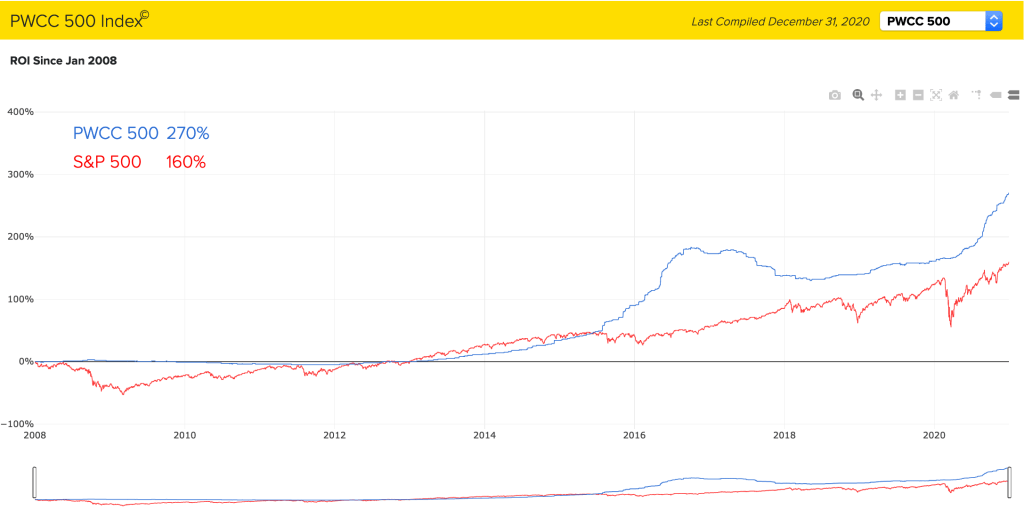
Need more convincing? Listed below are graphs from PWCC that show how the top 100 and 500 largest sports cards have tracked compared to the SP500 over the last 10 years. The returns are quite impressive:
So what does this mean for sports fans? Now, if you haven’t started already, is a great time to start collecting sports cards. Just make sure to do your research and ensure your cards are authenticated!
But what does this mean for the average, lazy investor such as myself? If you are like me, you get extremely excited about new ways to make money, but also:
Don’t want to spend hours researching individual rookie cards. You rather go snowboarding on the weekend.
Don’t have 100’s of thousands of dollars or millions to invest in cards.
Don’t want to physically hold onto these cards. While many others love showing off their 1952 Micky Mantle cards more than if they had the Mona Lisa in their basement, you want the freedom of having less possessions and being able to travel.
Don’t want to gamble on individual cards, but bet on the overall market of sports cards for the next 10 years.
So how do you avoid all these things, while still not missing out on this expanding market?
My answer: Index funds for sports cards. Companies like PWCC are already tracking the highest priced cards. Certain VC firms are even raising money to buy various cards. Yet, unlike the stock market, there are no publicly available index funds that the average investor can place a small amount of money in or own fractional shares. A couple companies such as Rally Rd. and Otis are getting closer to this, but currently only have crowdfunding for individual cards. Unless you buy a bunch of these, you still do not have a diversified portfolio.
In summary, I believe that there is a large gap in the current marketplace to make sports cards an easy, diversified option for the laymen investor. Only time will tell if someone or some companies can rise to the occasion and provide this offering to the public. And if/when that happens, when the rain falls, will people put out their buckets to catch the water?
Unfortunately, one of the first times I tried out the drone, it crashed into a tree and fell off a cliff into the water. (Shockingly, I wasn’t the one flying it, but it would have most assuredly been doomed to the same fate)
After making the claim on insurance, I went out and bought a new one.
I’ve had this new drone for the last couple weeks, yet have been fearful to fly it.
“What if I break it again on the first flight? Then I have to go through this whole process of acquiring and paying for a new one.”
But with that same type of thinking:
What is the point of wearing new shoes, if you are worried about getting them dirty?
The point of asking out a girl if you fear the rejection?
The point of applying for jobs where you won’t get an interview?
The point of trying out a new business that will most likely fail?
The answer to these questions is: we never really know what’s going to happen. We only know what will not happen if we don’t try.
In the words of Awolnation: “Never let your fear decide your fate.”
I surely won’t get that footage of Sunset Cliffs unless I take out the drone for a flight.

 Mitch's Blog