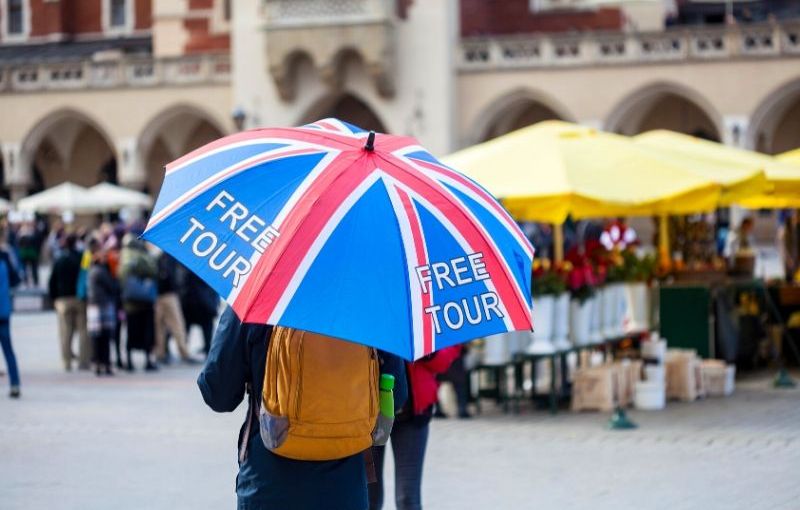
I’ve done walking tours across +25 countries in Europe, and the reason I keep coming back are for 4 main reasons:
- Free (just need to tip at the end)
- Gives a nice overview of the new city and helps me catch my bearings (Doing it the first day is incredibly helpful to find out cheap places to eat and where to go out)
- Opportunity to meet people (can’t tell you how many friends I’ve made from them)
- Gives me the ability to memorize one obscure fact that I can pawn off as my own knowledge in a random future pub to impress strangers (and ideally improve my chances of being seen as a not complete degenerate, or a worthy companion to a cute female)
With all that in mind, I’ve found quite a few similarities from country to country that I find entertaining/interesting. If you want to avoid some walking tours, become slightly less ignorant of the world, or improve your own chances of impressing your significant other / person of interest / pet cat, then feel free to read on about the weird facts.
Disclaimer: I’m going to make generalizations. These apply to some European cities, but obviously not all.
- Water out the window. Back in the day, to get rid of human waste (I’ll let you deduce what all of this encompasses), people would just toss it out of their window into the streets. To avoid it hitting the people below, a lot of cities had their own expressions to warn the people to move out of harm’s way. Scots would yell “gardyloo”, Spanish would yell “Aqua va!”, etc.
- Why do buildings have a second floor that sticks out further than the first floor? Answer: Taxes. A lot of cities used to charge based on the square footage from the ground, so people could save extra money if they built their homes with a smaller base
- Circular paint spots on old buildings? Most likely old bullet holes from a civil war.
- Why are staircases in castles built to spiral in a clockwise direction? Since castles were fortifications, these staircases were designed to be narrow and difficult for enemy soldiers to fight their way up. By building these staircases clockwise, the enemy (mostly right-handed) would need to round each curve of the wall before striking the defenders, often exposing themselves in the process. This gave the defenders a massive advantage, as they would be able to protect themselves using the inner wall and attack the enemy with their right hand wielding their swords. Other defense strategies were often put in place, such as intentionally making certain halls dark/dimly lit, having uneven stairs, trap doors in certain sections, holes where archers could shoot through, etc.
- Why was a certain city district destroyed? Always comes down to a couple things, which are easily guessable based on the region. Its either a natural disaster (earthquake, fire) or humans (wars)
- Every city in Europe swears they are “different from everyone else” and have a “cafe culture” where *shockingly, gasp* people love to drink coffee and gossip. Never would’ve guessed that. Can’t believe people like to be caffeinated or drink. Why would anyone ever do that.
- Rules of Equestrian Statues: If the horse is rearing up and has 2 feet raised off the ground, then the rider died in battle. If the horse has one foot raised, then the rider died of injuries sustained in action shortly after the battle ended. And if the horse has all four hooves on the ground, then the rider died of natural causes.
- Almost all things associated with culture and history can be explained by one of these 4 empires:
- Roman Empire – greatest influence on western culture—especially in regard to architecture, language, literature, art, and science
- Ottoman Empire – Islamic empire of Suleyman the Magnificent that covered: Southeastern Europe, Western Asia, and North Africa
- British Empire – had about a quarter of the planet and population at its height and colonies on every continent
- Macedonian Empire – one of the shortest-lived but most powerful empires in the world, under Alexander the Great
- Most cities have fallen to one of the 4 empires listed above, before eventually gaining their country’s independence
- Food is incredibly regionally based.
- Irish and English Breakfast is basically the same
- All the Balkans basically eat the same thing. Bureks for breakfast, some type of meat platter and salad for the other meals.
- Germany, Austria, and Hungary have similar cuisines (basis of meat and potatoes)
- Shall I go on?
- Mention of World War 1 or 2 and the effects it had on the city. (Communistic architecture, concentration camps, destroyed buildings, etc)
- Walking tours usually focus around Old Town, because Old Town > New Town – better for accommodation, restaurants, and nightlife usually
- Numbers of religion are fabricated and higher than actuality. Some censuses don’t even have an option for non-religious / atheists. Religion in some areas is also viewed as cultural (e.g. people will view themselves as Muslim but won’t practice or follow all rules)
- Eastern European countries are definitely more religious than Western European countries, and religion is still very much engrained in the city culture / practices
- Height limitations on city buildings – Unlike the US, there are not many skyscrapers due to the rules about buildings not being higher than a particular church or government building.
- Lot of old fortresses overlooking or in the outskirts of cities. These places where men have laid down their lives and fallen for the city has now been reduced to the make-out spot for teenagers
- Cities almost always have a strategic access to water, being built around a river or coastline, with an old system of wells or aqueducts in place
- Cities are either cat or dog focused, and they love em dearly.
- Edinburgh, Scotland has a statue erected for a dog (Greyfriars Bobby) that died 150 years ago. Many people call it the “most famous statue” in all of Edinburgh.
- Dubrovnik, Croatia once constructed a small house for a cat (Anastazija) on a step of the Rector’s Palace, and when the government decided to remove the house, it sparked an outrage amongst the people. The people protested and began writing negative reviews of the museum – bringing it down to 1.8 out of 10 stars. They also had an online petition that received more votes than what the mayor got when he was elected.
- Tours always start in the central square (called a piazza, plaza, etc.)
With all this in mind, the next time you find yourself in a new city, I highly recommend you do a walking tour. And I’ll also look forward to hearing your obscure, random fact over some drinks at the pub.
 Mitch's Blog